Chinese Zodiac Compatibility vs Western Astrology: Which Should You Trust in Love?
Chinese zodiac compatibility and western astrology don't actually contradict each other — they measure two different things. The Chinese animal reads the rhythm you were born into (your year, your family's tempo, how you show up in a group); the western sun sign reads the story you tell about yourself (your month, your inner motivation). When the two disagree about a relationship, trust the system that matches the question you're asking — not the one that flatters you. Neither is a verdict; both are just a vocabulary for the same human habits.
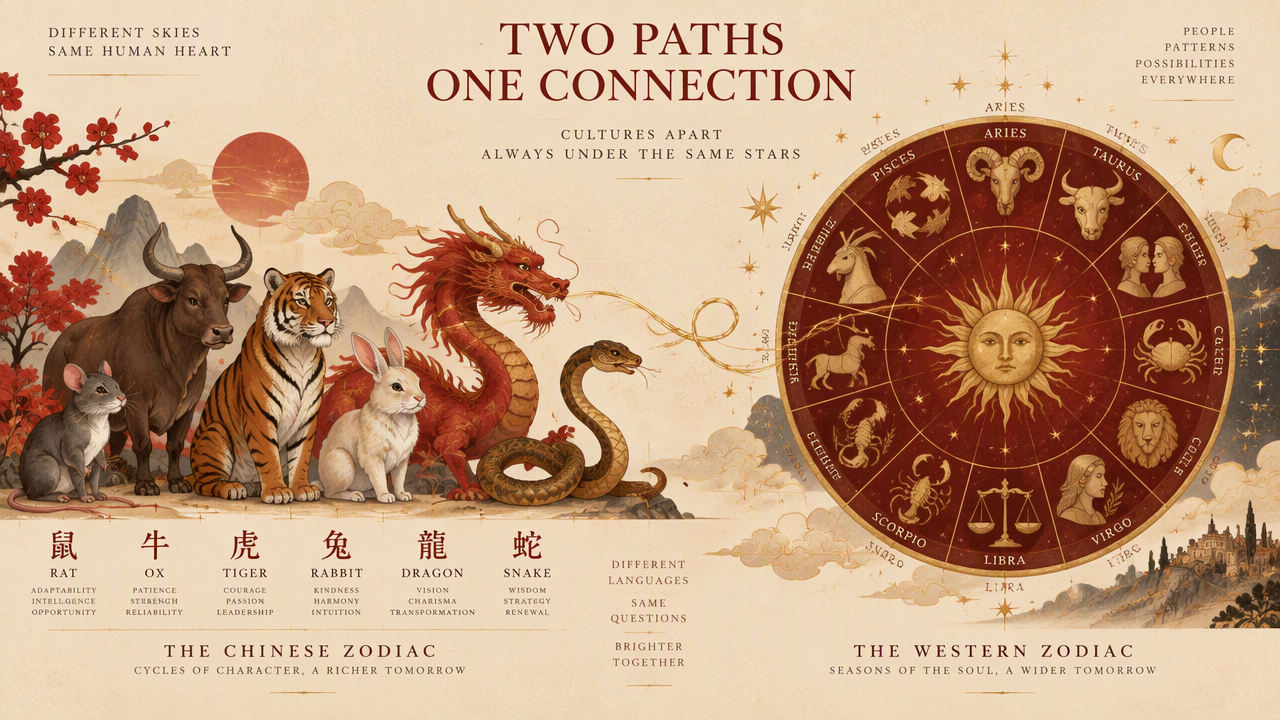
Two old systems, two different lenses. The animal looks at the year you were born into; the sun sign looks at the month. They were never trying to answer the same question.
If you grew up online, you've probably met both at once: a horoscope app telling you that you, a Libra, are "made" for an Aquarius, while a Chinese-zodiac chart warns that your Rabbit sign "clashes" with a Tiger. Same two people, two totally different verdicts. It feels like one of them has to be wrong. It almost never is — because they are reading different chapters of the same book.
Why the two systems feel like they're fighting
Both systems are, at root, personality shorthands dressed in different cultural clothes. The western sun sign is built on the month you were born — the slice of the calendar when the sun sat in a certain constellation. It describes a self-narrative: how you want to be seen, what you chase, the inner script you repeat. The Chinese animal is built on the year — and in the fuller tradition, the year is only one of four pillars in a birth chart, the one tied to family, lineage, and the public rhythm you inherit rather than choose.
So a "Dragon" is not the Chinese version of a "Leo." A Dragon is a description of how someone leads, protects, and refuses to be small in a room — a social-animal pattern. A Leo is a description of how someone wants to shine and be admired — a self-narrative pattern. Put them on the same person and you haven't got a contradiction; you've got two cameras pointed at two different parts of the same face. We go deeper on why the animal is only one eighth of the picture in our why-signs-clash piece.
The real difference: year vs month, family vs self
When you line the two up, the split is cleaner than the internet argues. Here is the quick map.
| Dimension | Chinese zodiac (animal) | Western astrology (sun sign) |
|---|---|---|
| What it's built on | Your birth year (one of four pillars) | Your birth month / sun position |
| What it describes | The rhythm you bring to groups and family | The story you tell about your inner self |
| Best at predicting | How two temperaments pull and push over time | Motivation, taste, and how you want to be loved |
| Blind spot | Says little about your private inner life | Says little about family tempo and inherited habit |
| Where it helps most | Long-term living, family, in-laws, work fit | First-date spark, self-understanding, "why do I want this?" |
The takeaway: the animal is strong where the sun sign is weak, and vice versa. A couple where the animals "clash" but the sun signs "match" isn't a glitch — it usually means they spark easily but live with friction. A couple where the animals harmonize but the sun signs clash often coexist calmly but struggle to feel understood. Neither sentence is a breakup; both are useful.
When they disagree, which one do you believe?
This is the question everyone actually wants answered, so here is a referee framework instead of a coin flip. Match the system to the worry:
1. "Do we have sparks and a natural first-date flow?" → lean on the sun signs. Western astrology is built for the meet-cute and the "why am I drawn to this person" question.
2. "Can we live in the same house for ten years without quietly resenting each other?" → lean on the animals. The year-sign logic is built for the long, unglamorous rhythm of shared life — the same lens we used for bosses, parents, and in-laws.
3. "Are we just fundamentally different people?" → use both, then let real behavior outvote both. A favorable label is not a license for control, and a clashing one is not a sentence. (Our guide to staying together despite a clash is built entirely on that principle.)
The mistake is picking the system that tells you what you already want to hear. If you're hoping the match is doomed, you'll quote the animal "clash." If you're hoping it's fated, you'll quote the sun-sign "trine." The honest move is to read the one that addresses the actual problem in front of you.
A reader's real question
One message captured the whole knot: "My boyfriend's a Tiger and I'm a Rabbit. Western astrology says we're great, but the Chinese chart says clash — which one do I actually believe?"
Translate it and the panic drops. Western says "great" because Tiger (bold, leading) and the air/fire signs that pair with Rabbit-types describe attraction and ease of first connection. Chinese says "clash" because a Tiger leads from the front and a Rabbit reads the room and steps back — over years, that can read as "he bulldozes, she disappears." Those are two true observations about two different layers. Believe both: you'll likely enjoy each other and also need to name the lead-versus-withdraw habit out loud. That exact Tiger–Rabbit tug is a cousin of the Snake-and-Tiger control-versus-freedom pattern we broke down elsewhere — same shape, different animals.
The 12×12 idea: cross-reference both instead of choosing
Most sites force you to pick a side. The more useful move is to run both and look for the overlap. Build a tiny two-axis read: your animal on one axis, your sun sign on the other. When both systems point at the same habit — say the animal says "slow to trust" and the sun sign says "guarded until proven" — you've found a real, repeated pattern worth talking about. When they disagree, you've found the layer where you two are easy and the layer where you'll have to work.
You don't need a fancy calculator to start. Sit down with your partner and answer one question for each system: "What does my animal say we'll rub on?" and "What does my sun sign say I want from love?" If the answers rhyme, that's your conversation. If they don't, that's still your conversation — just a richer one. For pair-by-pair animal breakdowns to fill in the first axis, browse from our zodiac compatibility home, or see how a famous "wrong on paper" pair actually lives in our Rat and Horse piece.
How to use both without losing your mind
Four habits keep two systems helpful instead of exhausting:
1. Use each for the question it's good at. Sparks → sun signs. Long-term living → animals. Stop asking the month-based system to predict your in-laws, and stop asking the year-based system to explain your secret inner life.
2. Watch for the flattery bias. You'll "believe" the system that agrees with what you want. Notice that, and read the uncomfortable one on purpose.
3. Let behavior outvote the charts. A partner who shows up, listens, and stays beats any "perfect match" label. The label is a vocabulary, not a scoreboard — the same point we make about dating someone with the same sign.
4. Keep it offline. Two systems is already enough noise. Don't add a third (MBTI, numerology, blood type) until you've actually talked to the human in front of you. Our modern-dating guide covers why the animal works best as a conversation starter, not a filter.
Questions people ask about Chinese zodiac compatibility and western astrology
"Is Chinese zodiac compatibility more accurate than western astrology for love?"
Neither is "more accurate" — they answer different questions. The animal is stronger at predicting long-term living rhythm and family fit; the sun sign is stronger at first-date spark and self-understanding. Use the one that matches what you're actually worried about, and let real behavior outvote both.
"Can you combine Chinese zodiac and western astrology for a better read?"
Yes, and it's usually more useful than picking a side. Run both on the same relationship and look for overlap: when the animal and the sun sign point at the same habit, that's a real pattern to discuss. When they disagree, you've found the layer where you're easy and the layer where you'll have to work.
"I'm a Dragon in Chinese zodiac but a Libra in western — which one is 'real'?"
Both are real, because they describe different things. The Dragon is how you lead and take up space in groups; the Libra is how you want partnership and fairness to feel. They aren't competing identities — they're two cameras on two parts of you. The friction only appears when you expect one label to explain your whole personality.
"My western match is perfect but our Chinese signs clash. What do I trust?"
Trust the system that matches the problem. Easy attraction and a great first year often come from the sun signs; the animal "clash" usually shows up later as a living rhythm — lead-versus-withdraw, fast-versus-slow. Name that habit out loud early, and the "clash" becomes a manageable rub, not a sentence. For how couples survive exactly that, see our stay-despite-clash guide.
For pair-by-pair animal breakdowns, start from the Chinese zodiac compatibility home, or read how a famous "wrong on paper" match actually plays out in our Dragon and Dog piece.