Rat and Horse Compatibility: Can the "Six Clash" Pair Actually Work?
Rat and Horse compatibility is the textbook "six clash" — the pairing the traditional charts flag as one of the worst. The short answer: the match is hard, but it is not doomed. The friction is real and predictable — the Rat plans while the Horse charges, the Rat guards while the Horse bolts for open space — and because it is predictable, it is fixable. Most Rat–Horse relationships that last do one thing consistently: they split "who thinks" from "who moves" so the two styles stop fighting each other and start covering each other.
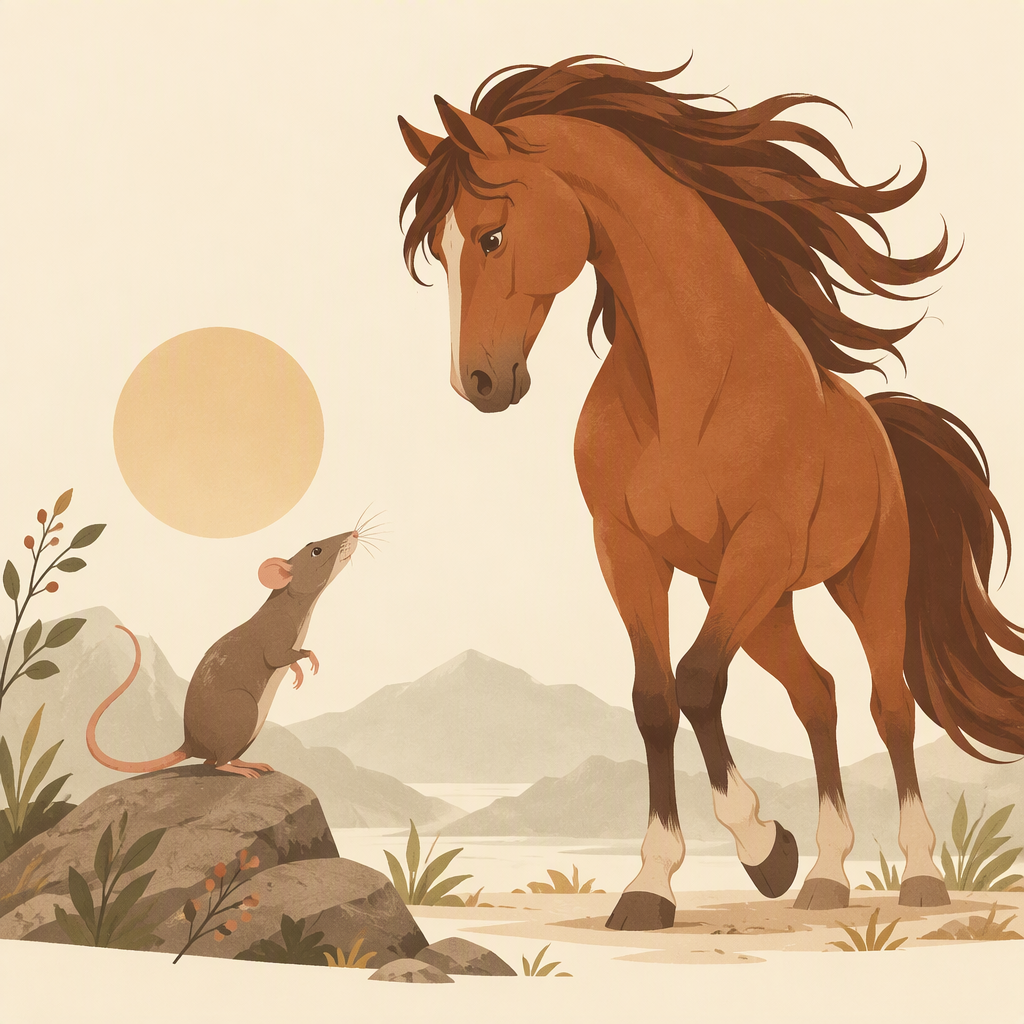
Same two animals, opposite engines: one reads the room, the other runs through it.
The animals are a shorthand for behavior, not a verdict. If you read them as descriptions of how each person shows up — who slows down to plan, who speeds up to act, how each handles a disagreement — they become a practical way to predict exactly where a Rat–Horse bond will be easy and where it will need a little maintenance.
Why Rat and Horse are the classic clash
In the traditional pairing system, Rat and Horse sit directly opposite each other, which is why they carry the "six clash" label. But the label is just a summary of a behavior pattern. The Rat moves through the world by gathering information, weighing risk, and securing the next step before committing. The Horse moves by momentum, instinct, and a strong need for freedom; being pinned down feels like being caged. Put those two engines in one relationship and you get a repeating loop: the Rat wants to decide after thinking, the Horse wants to think after deciding. Neither is wrong. They are simply out of phase.
That out-of-phase rhythm is the whole story. Everything difficult about this pair — the arguments, the withdrawals, the "you never listen / you never just go" complaints — traces back to it. And once you name the rhythm, you can change it on purpose instead of reliving it by accident.
The two behavior engines
Before the fixes, get clear on what each sign is actually doing, because the clash is not about love or respect — both are usually high. It is about operating tempo.
The Rat engine — planner and guard. The Rat likes a known plan, a cushion of savings, and a clear exit before saying yes. In conflict the Rat goes quiet and strategic: it re-plays the situation, looks for the safe move, and sometimes withholds a decision while it thinks. To the Horse this reads as cold, controlling, or evasive.
The Horse engine — mover and free spirit. The Horse likes motion, novelty, and saying yes now. In conflict the Horse goes loud and fast, says the thing, and then wants to be done and out the door. To the Rat this reads as reckless, careless, or like it never takes anything seriously.
Notice the trap: the Rat's silence makes the Horse push harder; the Horse's pushing makes the Rat retreat further. The more they loop, the more each one believes the other "just doesn't care the way I do."
Where they actually grind — three observable clashes
These are the three recurring scenes in a Rat–Horse relationship. None means the pair is broken; each has a specific fix below.
1. The decision-speed gap. Rat wants to think it through; Horse wants to decide tonight. Rat experiences Horse as impulsive; Horse experiences Rat as indecisive. The same plan gets re-litigated for weeks.
2. The freedom-vs-security tug. Horse needs open space and surprise; Rat needs a steady baseline and a plan. When Horse takes off spontaneously, Rat feels abandoned; when Rat asks for a fixed plan, Horse feels managed. Both are reacting to the same moment from opposite ends.
3. The conflict aftershock. Horse explodes, then moves on and expects things to be fine. Rat goes quiet, replays it for days, and never quite signals it is resolved. So Horse thinks it is over; Rat thinks it is still happening. They are on different clocks.
The fixes that make a Rat–Horse pair work
The goal is not to make the Rat reckless or the Horse cautious. The goal is to stop the two tempos from colliding and start letting them hand off.
Fix 1 — Split "who thinks" from "who moves." Agree out loud: the Rat owns the plan and the details; the Horse owns the momentum and the execution. When Horse wants to decide, it brings the move to Rat as a plan to refine, not a fait accompli. When Rat has thought, it hands a clear go/no-go to Horse within a set window (see Fix 2). Each person gets to do what they are good at, and the clash becomes a division of labor.
Fix 2 — The 24-hour window. The Rat gets a standing 24 hours to decide anything big without being pressed. The Horse agrees not to re-ask inside that window. This single rule removes most of the "you never commit" fights, because the Rat's thinking time is now respected instead of read as stalling.
Fix 3 — Name the aftershock. After any argument, Horse says one warm thing out loud ("we're good, I'm not going anywhere") and Rat says one line when it is actually done ("I'm reset now"). You are syncing two different recovery clocks so neither person is left guessing whether the relationship is still on fire.
Fix 4 — Pre-booked freedom. Horse gets scheduled solo time or spontaneous outings that Rat has already agreed to in principle. Rat is not being abandoned; it opted in. This keeps the Horse's need for space from reading as rejection, and keeps the Rat's need for notice from reading as control.
A weekly reset for the clash pair
Once a week, do a ten-minute version of the hand-off: Rat states the one plan it is holding, Horse states the one move it wants to make, and they confirm who owns what for the next seven days. Keep it concrete and short. The point is not to solve feelings; it is to keep the two engines pointed at the same target so the "six clash" label stops writing your arguments for you. Pairs like Snake and Tiger run the same playbook from a different angle, and our piece on staying together despite a bad compatibility label covers the mindset behind it.
Questions people ask about Rat and Horse matches
Are Rat and Horse really the worst match?
Traditionally, yes — they carry the direct "six clash" label, which puts them at the bottom of the old pairing charts. In real life it means the relationship will test your operating tempo more than a smoother pair would. "Worst match" describes a predictable friction pattern, not a sentence. Plenty of Rat–Horse couples last because they treat the friction as a known problem with known fixes.
"Everyone says Rat and Horse clash — should I even try?"
Try, but go in eyes open. The early stage feels electric because the two tempos are so different; the test comes later, when the loop of think-then-charge starts repeating. If you are both willing to split planning from momentum and respect each other's recovery clock, the label stops mattering. If one person insists the other must change tempo permanently, that is the real risk — not the signs.
Can a Rat and Horse friendship or work pair work better than romance?
Often, yes. Romance puts "who leads and who bends" on the table daily; a friendship or a work partnership lets you hand off by role instead. Rat as the strategist and Horse as the driver is a genuinely strong business combo, because each does what the other finds draining. For the friendship and work angle more broadly, see our take on zodiac compatibility for friendship.
What element combos make Rat and Horse better or worse?
The animal clash is the baseline, but the element layer changes the texture. A Water Rat with a Fire Horse leans fully into the cool-versus-hot dynamic; an Earth Rat with a Wood Horse softens the edges because Earth and Wood are less confrontational than Water and Fire. The element does not erase the clash, but it tells you whether the friction will feel like steam or like a slow simmer — useful when you are deciding how much structure to build.
How do I keep a Rat–Horse relationship from quietly ending?
Protect the weekly hand-off and the 24-hour decision window. The pairs that drift apart do not usually explode; they let the two clocks fall out of sync — Rat stewing, Horse assuming it is fine — until the distance feels normal. A short, concrete weekly sync is the hinge that keeps the match from silently downgrading. Or head back to the zodiac compatibility home to compare other pairs.