Chinese Zodiac Compatibility: Why Certain Signs Are Called "Incompatible"
Certain Chinese zodiac signs are called "incompatible" because they fall into a 2,000-year-old marriage-matching system — the six clashes, the six harms, and the six punishments — that was built to sort families for arranged marriages, not to judge whether two specific people can be happy. The label describes a rhythm between two animals, not a verdict on your relationship, and it is only one eighth of a full birth-chart reading. You were never doomed by it.
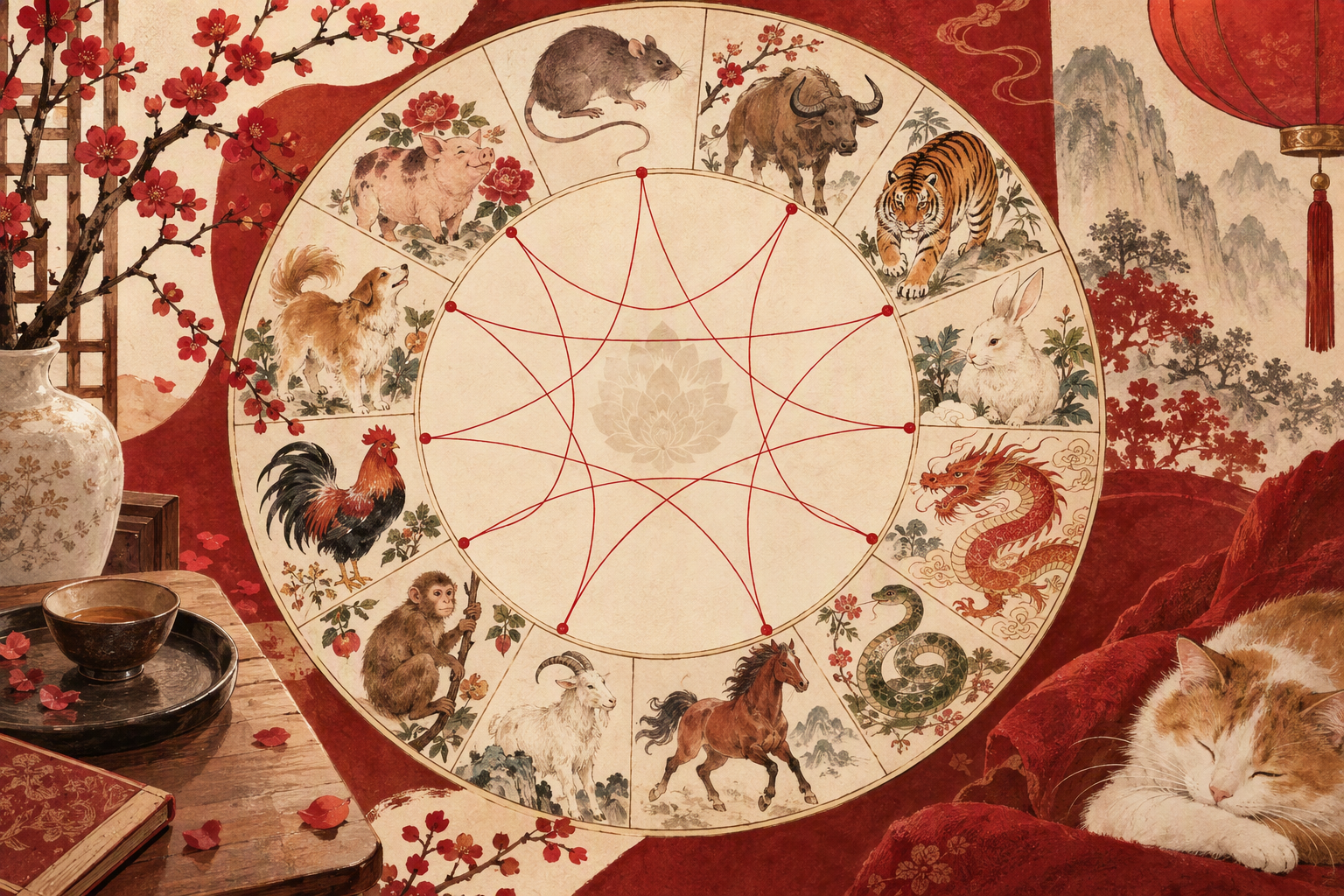
The "clash" lines were drawn for families choosing spouses across a village — not for you choosing a partner today.
If you have ever been told "you two clash" by a relative, or read that your sign is someone's "worst match," you have met the matching system. It is real, it is old, and it is specific — but almost nobody explains where it came from or what it was actually for. That gap is the whole point of this piece. Once you see the machine behind the label, the label stops feeling like a sentence.
The three systems behind every "incompatible" label
The word "incompatible" in Chinese zodiac talk is not one rule. It is shorthand for three separate traditional groupings, each with its own logic. Knowing which one someone means changes everything.
The six clashes (六冲). These are the direct opposites on the zodiac wheel, twelve years apart: Rat–Horse, Ox–Goat, Tiger–Monkey, Rabbit–Rooster, Dragon–Dog, Snake–Pig. In the old logic, opposites pull in opposite directions — one pushes, the other pulls. It is the most common thing people mean by "we clash."
The six harms (六害). A subtler and older list, remembered in a folk rhyme that grandparents still quote: the Rat and Goat "part in a single breath," the Horse "fears the Ox," the Snake and Tiger "grind like a file," the Rabbit and Dragon "shed tears," the Rooster and Dog "weep together," the Monkey and Pig "never reach the end." These were warnings whispered at matchmaking tables, not laws of nature.
The six punishments (相刑). The most technical of the three, used in full birth-chart work: the Rat–Rabbit "without-gratitude" punishment, the Tiger–Snake–Monkey "abuse-of-power" triangle, the Ox–Dog–Goat "breach-of-rite" group, and the self-punishments where the same animal repeats (Dragon–Dragon, Horse–Horse, Rooster–Rooster, Pig–Pig). This one barely appears in casual compatibility talk, but it is why some "same sign" pairs get flagged too — see our same-sign breakdown.
None of these systems was invented to make people anxious on a date. They were sorting shortcuts.
Where the labels actually came from
The honest origin story is practical, not mystical. For most of Chinese history, marriage was arranged by families, often between people who had never met. Parents needed a fast, repeatable way to screen a stranger from another village: same social standing? Same region? And — using the only birth detail most families reliably knew — the same animal year? A "clash" was a cheap reason to say no without offending anyone. It was a family-level risk filter, not a promise about two individuals.
Here is the part almost every "best and worst match" list leaves out: the animal is only the year pillar (年柱) of a full birth chart (八字). A complete reading has four pillars — year, month, day, and hour — eight characters in total. Judging a whole relationship on the animal alone is using one eighth of the data, then treating that eighth as the whole answer. The old masters who built the system never claimed the animal was enough; the internet shortened it into a yes-or-no.
A concrete example: the "Snake and Tiger" harm
Take the pair the folk rhyme calls "grind like a file" — the Snake and the Tiger, a six-harms match. What the label actually describes is a recognizable behavioral friction: the Tiger moves outward, leads, and claims the room; the Snake moves inward, guards privacy, and watches before acting. Put them together and you can get a control-versus-freedom tug that, if unnamed, feels like grinding. That is a habit rhythm, not a curse.
And it is exactly why a reader's question keeps showing up in Western forums: "Everyone says Snake and Tiger clash, but we've been fine for six years — what gives?" The answer is right there in the reframe. They are fine because they are two people who learned to handle one friction, not because they defeated an ancient law. A label that predicts a tendency says nothing about whether you manage the tendency. We dig into this specific pairing in our Snake and Tiger compatibility piece, and the same logic applies to the famous Dragon and Dog clash.
Why "incompatible" was never a death sentence
The system was a first filter for strangers, not a final word for partners. Two points keep that in view:
"A clash label points at one predictable friction between two animals. It is not a measure of love, effort, or safety — and a favorable label is not a license for control, coldness, or harm."
If a relationship is unsafe, that is conduct, not incompatibility, and no chart explains it away. And if a relationship is good, no "clash" invalidates it. The animals describe a starting shape; the people fill it in.
How to use the label without being ruled by it
Four habits turn an ancient filter into a modern tool:
1. Name which system someone means. "We clash" could be a six-clash, a six-harm, or a punishment. Ask. Half the dread disappears once you see it is a generic category, not a personal diagnosis.
2. Translate the label into one habit to discuss. Snake–Tiger becomes "who leads and who needs space." Rat–Horse becomes "fast decision-maker versus slow one." The label is useful only as a word for a pattern you then choose to manage.
3. Remember it is one eighth. The animal is the year pillar of a full chart. If a mismatch worries you, the responsible move is a proper birth-chart reading, not a panic over a single animal.
4. Let behavior outvote the animal. How you actually treat each other in a month will tell you more than any pairing table. For the standing agreement that survives any "wrong on paper" match, read our guide to staying together despite a clash.
Questions people ask about why zodiac signs clash
"Why are some Chinese zodiac signs called incompatible?"
Because they fall into traditional grouping systems — the six clashes (opposites on the wheel), the six harms (a folk rhyme of warned pairs), and the six punishments (used in full birth charts). These were built centuries ago as a quick family-level filter for arranged marriages, not as a judgment on two individuals today.
"Does 'incompatible' mean the relationship is doomed?"
No. The animal is only the year pillar, one eighth of a complete birth-chart reading, and it describes a rhythm between two signs, not an outcome. Plenty of "clashing" pairs stay together for decades because they manage the one friction the label points at.
"What does 'Snake and Tiger clash' actually mean?"
They are a six-harms pair in the old folk rhyme, which warns they "grind like a file." Behaviorally that points at a control-versus-freedom friction — the Tiger leads outward, the Snake guards privacy — not a curse. Many such pairs are perfectly happy once they name and handle that one dynamic.
"Should I avoid dating someone with a clashing sign?"
No. Treat the clash as a single habit to discuss, not a reason to reject someone. Use it as vocabulary for the one friction you'll likely bump into, then let real behavior decide — exactly the approach in our modern dating guide and our stay-despite-clash piece.
For more pair-by-pair breakdowns, start from the Chinese zodiac compatibility home or see how a famous "clash" actually plays out in our Rat and Horse piece.