Snake and Horse Compatibility: When the Strategist Meets the Free Spirit
Snake and Horse compatibility is the pairing of the strategist and the runner. They are not on the formal "six-clash" list, and they are not a destined trine match either. On paper they look like opposites — the Snake wants to watch, plan, and keep its cards close; the Horse wants to move, speak, and feel the wind. In practice the relationship works when the Snake stops reading the Horse as reckless and the Horse stops reading the Snake as secretive, and both treat the gap as a division of labor instead of a character flaw. The friction is predictable, and almost all of it is fixable.
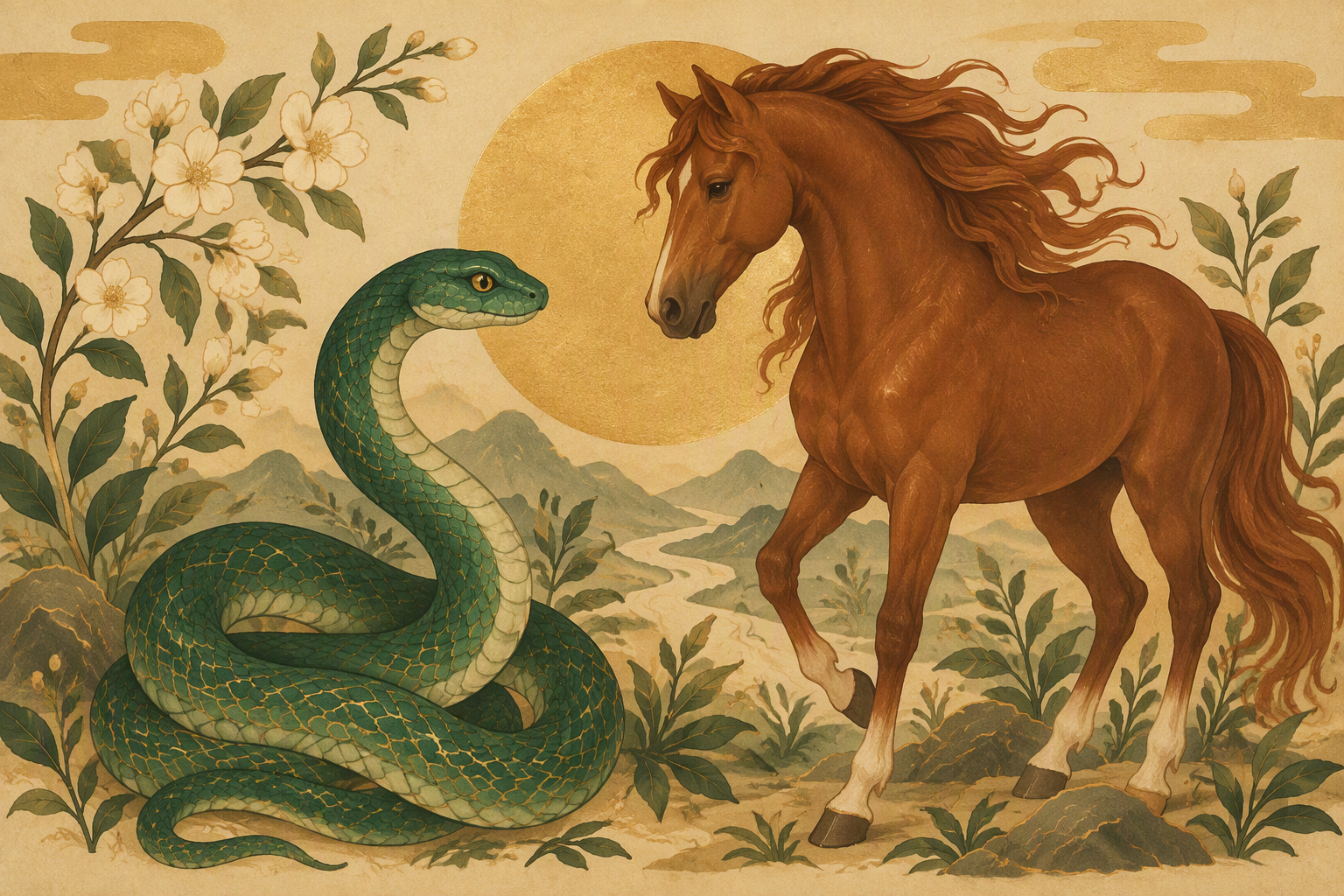
The Snake holds the plan; the Horse holds the momentum. The pairing works when those become two jobs, not a fight.
The animals are a shorthand for behavior, not a verdict. Read the Snake as "needs to understand before it commits" and the Horse as "needs to move before it suffocates," and the pairing stops being a mystery. Most Snake–Horse trouble is not about love or loyalty — it is about a private planner sharing a life with an open runner.
Why Snake and Horse look like a mismatch on paper
They sit in different trines. The Snake belongs to the Ox–Snake–Rooster trio, the quiet professionals who value control, competence, and a contained life; the Horse belongs to the Tiger–Horse–Dog trio, the loyalists who crave movement, novelty, and a cause to charge toward. Traditional match lists put them in the "needs effort" column rather than the "destined" column — and that label alone makes a lot of couples anxious before they have even had a real argument.
The gap is not moral. It is a wiring gap. The Snake moves by understanding first; the Horse moves by acting first. When you share a life, that gap shows up in how you make a plan, share a secret, and handle a surprise — and it reads as a personality flaw long before anyone names it as a rhythm difference.
Three observable behavior mechanisms where they friction
Skip the "are we compatible" question. Watch what actually happens, because these three patterns explain nearly every Snake–Horse argument you will ever have.
1. Private versus broadcast. The Snake keeps its feelings and plans to itself until it is sure; the Horse processes everything out loud and wants to share the whole movie as it watches it. The Snake reads the Horse as chaotic and over-sharing; the Horse reads the Snake as cold and secretive. The same silence — the Snake thinking — gets experienced as two different betrayals: to the Snake it is focus, to the Horse it is distance. Neither is lying; they are just running on opposite information clocks.
2. Understand-first versus move-first. The Snake decides after watching and mapping the room; the Horse decides and then learns on the way. The Snake reads the Horse as reckless; the Horse reads the Snake as slow and as someone who never actually commits. The same moment — the Horse wanting to go, the Snake wanting to think — becomes a small war about who respects whom, when in reality both are just trying to feel safe in their own language.
3. Containment versus flight. The Snake is territorial and likes a world it controls; the Horse recoils from anything that feels like a fence. The Snake's "let's keep this close and quiet" feels like control to the Horse; the Horse's "I need to go" feels like abandonment to the Snake. The same Saturday plan gets experienced as two different threats — to the Snake it is the loss of a held-together life, to the Horse it is the loss of air.
Four concrete fixes that actually change the day-to-day
These are not vague "communicate more" slogans. They are specific agreements that remove the grind.
Fix 1 — The Snake's "I'm deciding, not hiding" rule. The Snake names out loud when it is still thinking versus when it has made up its mind. A single sentence — "I haven't decided yet, give me two days" — stops the Horse from filling the silence with the worst story. You are separating "I am processing" from "I am keeping something from you," and that one habit defuses most of the suspicion before it starts.
Fix 2 — The Horse's "heads-up before the gallop" rule. The Horse gives the Snake a 24–48 hour warning before a big spontaneous move — a trip, a purchase, a job change — so the Snake's nervous system is not ambushed. In return the Snake agrees to say yes to one unplanned thing a month. You are separating "I like surprise" from "I am abandoning the plan," and the Snake stops reading the Horse as a runaway.
Fix 3 — Divide the map. The Snake owns the strategy and the long view — the money, the plan, the thing that keeps the life coherent. The Horse owns the momentum and the execution — the social spark, the trip, the energy that makes the plan worth having. Each runs their lane and stops judging the other's. The Snake gets a life that holds together; the Horse gets a life that moves. Neither has to become the other, which is the part most Snake–Horse couples get stuck on.
Fix 4 — One recurring anchor ritual. Snake and Horses bond through a steady thing they always do, not through processing feelings. A standing dinner, walk, or project gives the relationship a hinge that survives the fights. When life gets busy and the talking stops, the shared ritual is what keeps them from quietly drifting — and drifting is the real risk for this pair, not fighting.
The ten-minute version
Once a month, the Snake names one thing the Horse did that felt like love, and one thing it wishes the Horse would slow down on. The Horse answers in words, not gestures. The point is not to solve anything; it is to keep the "I've got you" signal alive so the relationship does not quietly downgrade to a polite coexistence. The Snake needs this the most and offers it the least — which is exactly why it has to be scheduled, not waited for.
Questions people ask about Snake and Horse matches
Are Snake and Horse compatible in love?
Often better than the charts suggest, once the private-versus-open gap is named. They are not a trine "easy" pair, but both are loyal, sharp, and stubborn in their own way — and the stubbornness cuts both directions: it keeps them together as often as it locks them apart. The couples who last stop treating the Horse's openness as carelessness and the Snake's privacy as withdrawal. They are a partnership of contrast, not a mismatch — and contrast, unlike fate, is something you can negotiate.
"My partner is a Horse and I'm a Snake — we fight about secrets and plans. Is that the sign or us?"
The privacy gap is the classic Snake–Horse friction, so the sign explains the shape of it, not the fact that you fight. The fix is structural: the Snake says "I'm deciding, not hiding," and the Horse gives a heads-up before the big move. Once the Snake feels included instead of ambushed, the Horse stops feeling caged, and the secrecy fights turn into planning conversations. That is the whole game with this pair — name the rhythm and the fighting loses its fuel.
Is Snake and Horse a six-clash pair?
Neither a six-clash nor a six-harm pair. They are not on the formal list of assigned oppositions (those are specific pairs like Rat–Horse or Snake–Pig) nor the "six harms" list. They are what traditional matchmakers call a "needs-understanding" pair — friction from temperament, not from an assigned conflict. That is genuinely good news: temperament is something two people can sit down and negotiate, whereas an assigned conflict always feels like fate.
Can a Snake and Horse be friends, or is it only hard in romance?
Easier as friends than as partners, for the same reason as other intense pairs: friendship has no "who runs the life" stake. The Snake gets a bold, sunny friend who drags it somewhere new; the Horse gets a steady, strategic friend who keeps it from galloping off a cliff. The secrecy tension mostly shows up in romance, where silence feels like a verdict. Take that pressure off and the two make a surprisingly strong team — see how this plays out in Dragon–Snake and Snake–Tiger as well.
If you want the broader framework for pairs that friction but last, read our take on staying together despite a "clash" label, or head back to the zodiac compatibility home to compare other pairs. The Rat–Horse and Ox–Tiger breakdowns use the same behavior-first method, and the Ox–Goat pairing is the closest cousin to this one.