Dragon and Snake Compatibility: What Really Happens When the Showman Meets the Strategist
Dragon and Snake compatibility is one of the more misunderstood pairings in the Chinese zodiac. They are not a natural trine match, and they are not a textbook "six-clash" disaster either. On paper they look mismatched — the Dragon is loud, public, and vision-driven; the Snake is private, strategic, and guarded. In practice the relationship works when both stop trying to convert the other and start using the difference as a division of labor. The friction is predictable, and almost all of it is fixable.
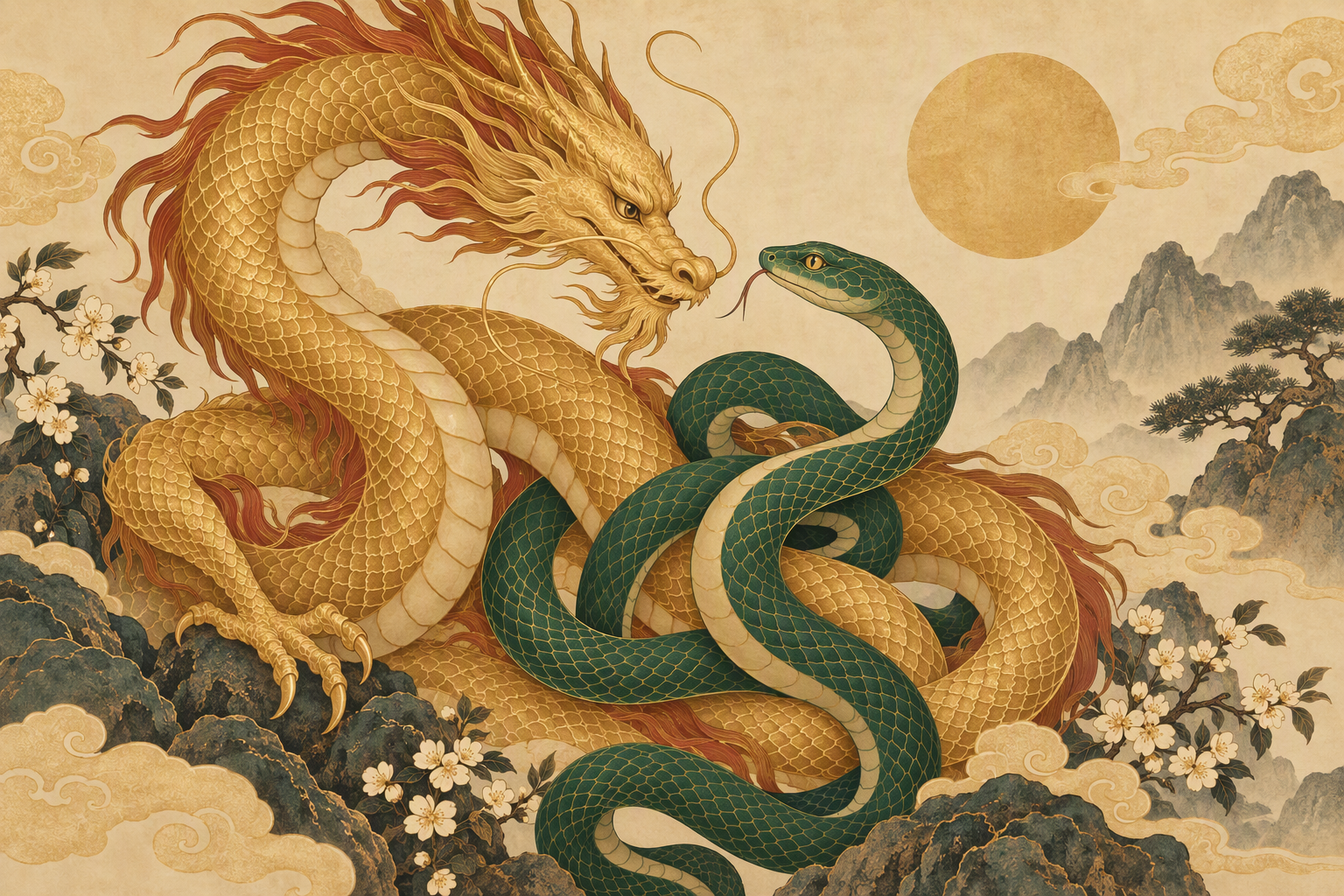
The Dragon wants the spotlight; the Snake wants the strategy room. The pairing works when those become two jobs, not a fight.
The animals are a shorthand for behavior, not a verdict. Read the Dragon as "needs to be seen" and the Snake as "needs to be trusted with the real plan," and the pairing stops being a mystery. Most Dragon–Snake trouble is not about love or loyalty — it is about two opposite ways of processing the world sitting at the same table.
Why Dragon and Snake look like a mismatch on paper
They sit in different trines. The Dragon belongs to the Rat–Dragon–Monkey trio, the movators who like momentum and a crowd; the Snake belongs to the Ox–Snake–Rooster trio, the quiet professionals who value competence and dislike exposure. Traditional match lists put them in the "needs effort" column rather than the "destined" column — and that label alone makes a lot of couples anxious before they have even had a real argument.
The gap is not moral. It is an operating-style gap. The Dragon processes out loud and in public; the Snake processes in private and reveals only the conclusion. When you are dating or living with someone, that gap shows up in everything from how you make plans to how you fight, and it reads as a personality flaw long before anyone names it as a rhythm difference.
Three observable behavior mechanisms where they friction
Skip the "are we compatible" question. Watch what actually happens, because these three patterns explain nearly every Dragon–Snake argument you will ever have.
1. Spotlight versus shadow. The Dragon recharges by being witnessed — ideas, wins, presence, the room noticing them. The Snake's instinct is to keep the real plan close and observe before acting. The Dragon reads that privacy as secrecy or coldness; the Snake reads the Dragon's openness as exposure or ego. Neither is wrong; they are just running on opposite batteries.
2. Declare versus deduce. The Dragon announces intent and expects momentum: "Here's the plan, let's go." The Snake tests, watches, and decides late. The Dragon feels slowed and second-guessed; the Snake feels rushed and bulldozed. The same moment — the Dragon wanting to move, the Snake wanting to wait — gets experienced as two different betrayals.
3. Grand vision versus quiet control. The Dragon wants the big, visible move and the story that comes with it. The Snake prefers to steer from behind the scenes, where the real leverage lives. The Dragon can feel the Snake is withholding the wheel; the Snake can feel the Dragon is driving off a cliff just to have an audience. Both are trying to protect the relationship, and both think the other is reckless.
Four concrete fixes that actually change the day-to-day
These are not vague "communicate more" slogans. They are specific agreements that remove the grind.
Fix 1 — Split the stage. The Dragon gets the public role (presenting, hosting, being the face); the Snake gets the advisory seat (the real strategy, the read on people). Say it out loud: "You're the face, I'm the brain trust." Resentment drops the moment the division is agreed instead of implied. The Dragon stops feeling managed, and the Snake stops feeling performed-for.
Fix 2 — The Snake's "say it in words" rule. The Snake's biggest relationship risk is staying silent until resentment hardens into distance. A standing rule: if something matters, it has to be said in words, not communicated through withdrawal. The Dragon cannot fix what it cannot see. A sentence today beats a cold week next month.
Fix 3 — Separate "I'm thinking" from "I'm blocking." When the Dragon wants to move and the Snake hasn't answered, the Dragon says: "I'll act in 24 hours unless you object." That turns the Snake's silence from a wall into a timed pause, and the Snake learns to use the window instead of letting it expire. You are separating "I need to think" from "I am blocking you" — the single most useful habit in this pairing.
Fix 4 — One recurring side-by-side thing. Dragons and Snakes bond through doing, not through processing feelings. A standing project, trip, or ritual they run together gives the relationship a hinge that survives the fights. When life gets busy and the talking stops, the shared activity is what keeps them from quietly drifting.
The ten-minute version
Once a month, the Dragon names one thing the Snake did that made them feel backed, and one thing they are low-key unsure about. The Snake answers in plain words, not hints. The point is not to solve anything; it is to keep the "I've got you" signal alive so the relationship does not quietly downgrade to a polite coexistence. The Snake needs this the most and offers it the least — which is exactly why it has to be scheduled, not waited for.
Questions people ask about Dragon and Snake matches
Are Dragon and Snake compatible in love?
Often better than the charts suggest, once the style gap is named. They are not a trine "easy" pair, but both are proud, intelligent, and loyal in their own way. The couples who last stop treating the Snake's privacy as a slight and the Dragon's need for recognition as vanity. They are a partnership of contrast, not a mismatch — and contrast, unlike fate, is something you can negotiate.
"My partner is a Snake and I'm a Dragon — we fight about attention. Is that the sign or us?"
The attention gap is the classic Dragon–Snake friction, so the sign explains the shape of it, not the fact that you fight. The fix is structural: the Dragon asks for acknowledgment directly instead of performing for strangers, and the Snake learns that a little public credit costs almost nothing and buys a lot of peace. Once the Dragon feels seen at home, it stops hunting the spotlight elsewhere.
Is Dragon and Snake a six-clash or six-harm pair?
Neither. They are not on the formal "six clashes" list (those are specific oppositions like Rat–Horse or Tiger–Snake) nor the "six harms" list. They are what traditional matchmakers call a "needs-understanding" pair — friction from temperament, not from an assigned conflict. That is genuinely good news: temperament is something two people can sit down and negotiate, whereas an assigned conflict always feels like fate.
Can a Dragon and Snake be friends, or is it only hard in romance?
Easier as friends than as partners, for the same reason as other intense pairs: friendship has no "who leads the life" stake. The Dragon gets a loyal, sharp advisor; the Snake gets a friend who pulls them into the light. The spotlight-versus-shadow tension mostly shows up in romance, where attention feels like proof of love. Take that pressure off and the two make a surprisingly strong team — see how this plays out in Snake–Tiger and Dragon–Dog as well.
If you want the broader framework for pairs that friction but last, read our take on staying together despite a "clash" label, or head back to the zodiac compatibility home to compare other pairs. The Rat–Horse and Ox–Goat breakdowns use the same behavior-first method.