Dragon and Dog Compatibility: Can the "Six Clash" Loyalists Make It Work?
Dragon and Dog compatibility carries the traditional "six clash" label — the Dragon and the Dog sit directly opposite each other, and the old charts read it as a hard match. The short answer: it is a difficult pairing, not a doomed one. The friction is predictable — the Dragon wants to rise, declare, and be admired; the Dog wants to guard, scan for threats, and be sure you are loyal — and because it is predictable, it is fixable. The Dragon–Dog pairs that last stop fighting over who is "right" and start handing off: the Dragon owns the vision and the momentum, the Dog owns the risk-watch and the loyalty anchor.
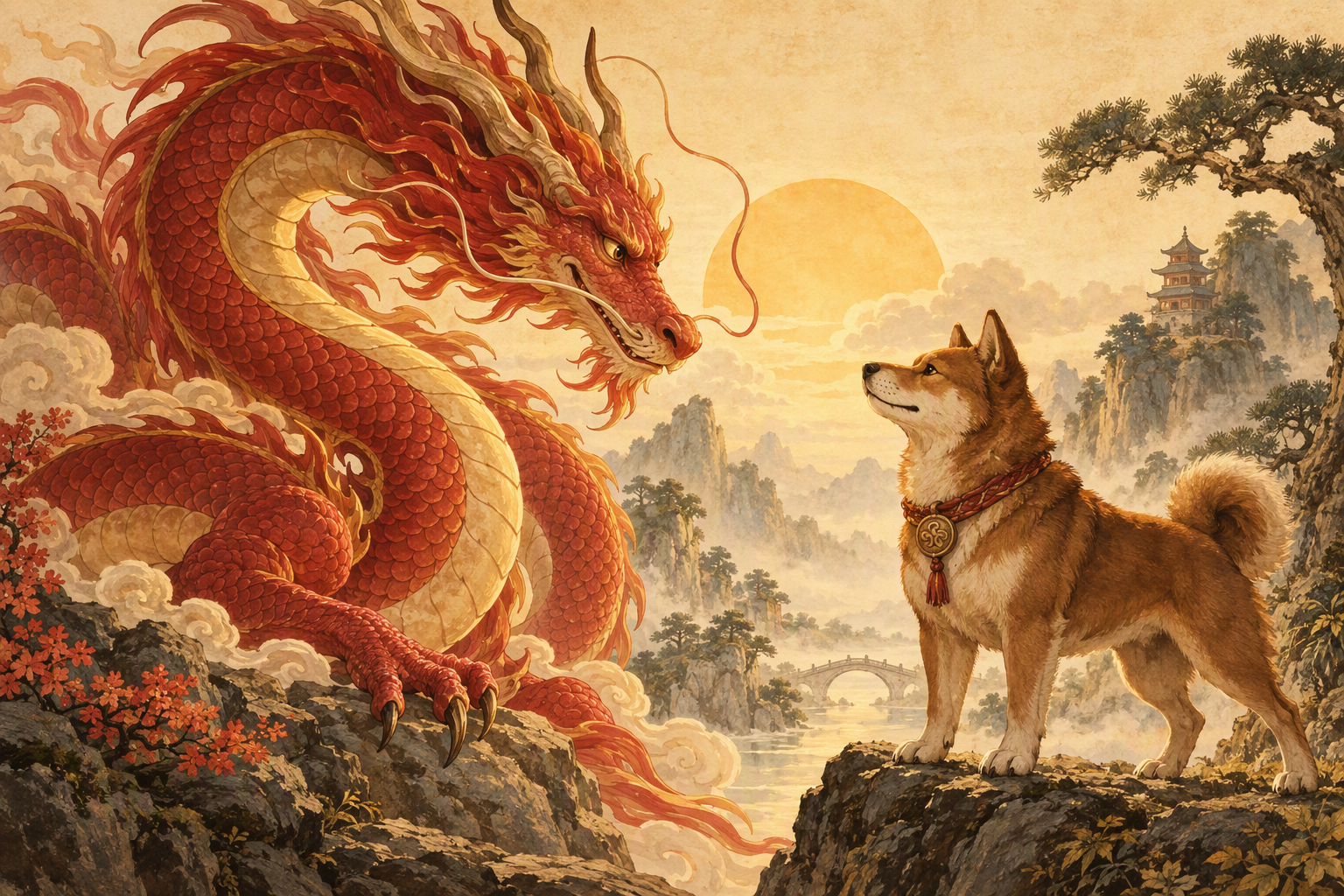
Same two animals, opposite engines: one wants to be seen rising, the other wants to be sure you are safe.
The animals are a shorthand for behavior, not a verdict. If you read them as descriptions of how each person shows up — who needs the spotlight, who needs the reassurance, how each handles a disagreement — they become a practical way to predict exactly where a Dragon–Dog bond will be easy and where it will need a little maintenance.
Why Dragon and Dog are the classic clash
In the traditional pairing system, the Dragon and the Dog sit directly opposite each other, which is why they carry the "six clash" label. But the label is just a summary of a behavior pattern. The Dragon moves through the world by vision, boldness, and being seen — it likes grand gestures, big declarations, and an audience. The Dog moves by protection, loyalty, and a healthy suspicion of hype — it likes steadiness, scanning for threats, and a small circle it can trust completely. Put those two engines in one relationship and you get a repeating loop: the Dragon declares big, the Dog guards hard. Neither is wrong. They are simply out of phase.
That out-of-phase rhythm is the whole story. Everything difficult about this pair — the "you're so full of yourself" fights, the "you never trust me" withdrawals, the cold shoulders that come out of nowhere — traces back to it. And once you name the rhythm, you can change it on purpose instead of reliving it by accident.
The two behavior engines
Before the fixes, get clear on what each sign is actually doing, because the clash is not about love or respect — both are usually very high. It is about how each one proves they care.
The Dragon engine — visionary and center-stage. The Dragon likes a bold plan, a grand gesture, and the feeling of being admired for it. In conflict the Dragon goes big and loud to "clear the air," says the dramatic thing, and then wants to move on and be done. To the Dog this reads as flashy, self-promoting, or like it never follows through on the speech.
The Dog engine — loyal guardian. The Dog likes a steady baseline, a protected inner circle, and quiet proof that you will not bolt. In conflict the Dog goes quiet, guards its trust, and holds the grievance long after the surface argument ended. To the Dragon this reads as suspicious, dampening, or like it can never be satisfied no matter what the Dragon does.
Notice the trap: the Dragon's big declarations make the Dog brace for empty promises; the Dog's guardedness makes the Dragon perform even bigger to win approval. The more they loop, the more each one believes the other "just doesn't love me the way I need."
Where they actually grind — three observable clashes
These are the three recurring scenes in a Dragon–Dog relationship. None means the pair is broken; each has a specific fix below.
1. The spotlight-versus-watchdog gap. Dragon wants applause and a bold move; Dog wants to scan the room and protect the flank. Dragon experiences Dog as a killjoy who dims every moment; Dog experiences Dragon as all flash with no substance. The same evening gets rated completely differently by each.
2. The trust tempo gap. Dog trusts slowly and guards loyalty hard; Dragon assumes loyalty is settled and moves on fast. When Dog checks in or asks twice, Dragon feels unappreciated; when Dragon surges ahead without a backward glance, Dog feels unchecked and unprotected. Both are reacting to the same moment from opposite ends.
3. The conflict aftershock. Dragon explodes, declares the air cleared, and expects things to be fine. Dog goes quiet, replays the slight, and never quite signals it is resolved. So Dragon thinks it is over; Dog thinks it is still happening. They are on different clocks.
The fixes that make a Dragon–Dog pair work
The goal is not to make the Dragon small or the Dog naive. The goal is to stop the two tempos from colliding and start letting them hand off.
Fix 1 — Split "who inspires" from "who protects." Agree out loud: the Dragon owns the vision and the momentum; the Dog owns the risk-watch and the loyalty anchor. When the Dragon wants to make a big move, it brings it to the Dog as a plan to stress-test, not as a performance to applaud. The Dog's job is to poke the holes — which is protection, not criticism. Each person gets to do what they are good at, and the clash becomes a division of labor.
Fix 2 — The explicit trust signal. The Dragon says one warm, specific reassurance out loud on a regular beat ("I've got you, you're my person, I'm not going anywhere") instead of assuming it is obvious. The Dog agrees to say one line when it is actually reset ("I'm good now"). You are syncing two different recovery clocks so neither person is left guessing whether the relationship is still on fire.
Fix 3 — Pre-frame the big move. Before the Dragon declares something grand, it names the motive: "I'm doing this because I believe in it, not to show off." That single sentence stops the Dog from reading vanity into every bold gesture, which is the trigger that starts most of their loops.
Fix 4 — A pre-booked loyalty ritual. The Dog gets one recurring, steadying check-in — a walk, a call, a Sunday thing — that the Dragon shows up for reliably. It is not spectacular; that is the point. The Dog needs proof of consistency more than proof of passion, and a boring ritual delivered every time beats a grand gesture delivered once.
A weekly reset for the clash pair
Once a week, do a ten-minute version of the hand-off: the Dragon states the one bold move it wants to make, the Dog states the one risk it wants to watch, and they confirm who owns what for the next seven days. Keep it concrete and short. The point is not to solve feelings; it is to keep the two engines pointed at the same target so the "six clash" label stops writing your arguments for you. Pairs like Rat and Horse run the same playbook from a different angle, and our piece on staying together despite a bad compatibility label covers the mindset behind it.
Questions people ask about Dragon and Dog matches
Are Dragon and Dog really a bad match?
Traditionally, yes — they carry the direct "six clash" label, which puts them at the bottom of the old pairing charts. In real life it means the relationship will test your loyalty tempo more than a smoother pair would. "Bad match" describes a predictable friction pattern, not a sentence. Plenty of Dragon–Dog couples last because they treat the friction as a known problem with known fixes.
"Everyone says Dragon and Dog clash — should I even try?"
Try, but go in eyes open. The early stage feels exciting because the Dragon's fire draws the Dog in and the Dog's steadiness steadies the Dragon. The test comes later, when the loop of declare-then-guard starts repeating. If you are both willing to split inspiration from protection and respect each other's recovery clock, the label stops mattering. If one person insists the other must change engines permanently, that is the real risk — not the signs.
Can a Dragon and Dog friendship or work pair work better than romance?
Often, yes. Romance puts "who is seen and who is sure" on the table daily; a friendship or a work partnership lets you hand off by role instead. A Dragon founder with a Dog operator is a genuinely strong business combo, because the Dragon supplies the vision everyone rallies behind while the Dog supplies the loyalty and the risk-watch that keeps it from flying off a cliff. For the friendship and work angle more broadly, see our take on zodiac compatibility for friendship.
What element combos make Dragon and Dog better or worse?
The animal clash is the baseline, but the element layer changes the texture. An Earth Dragon with an Earth Dog softens the edges, because Earth is the calmest, most grounding element for both. A Fire Dragon with a Metal Dog leans fully into the flash-versus-guard dynamic and needs the most structure. The element does not erase the clash, but it tells you whether the friction will feel like a shouting match or like a slow, guarded simmer — useful when you are deciding how much of the weekly reset to build.
How do I keep a Dragon–Dog relationship from quietly ending?
Protect the weekly hand-off and the explicit trust signal. The pairs that drift apart do not usually explode; they let the two clocks fall out of sync — Dragon performing for an empty room, Dog guarding a grievance nobody named — until the distance feels normal. A short, concrete weekly sync plus one real reassurance said out loud is the hinge that keeps the match from silently downgrading. Or head back to the zodiac compatibility home to compare other pairs.