Dragon and Rabbit Compatibility: The Pair That Needs a Quiet Corner
Dragon and rabbit compatibility is a traditional "six-harm" (liuhai) pairing, the kind the old lists flag as "needs understanding." In plain behavior terms that means the friction is real but predictable: the Dragon wants the stage, the spotlight, and the bold move, while the Rabbit wants a calm corner, a soft landing, and no sudden pressure. The match works when the Dragon stops reading the Rabbit's quiet as disapproval, and the Rabbit stops reading the Dragon's noise as a demand. The rest is tempo, not a values clash.
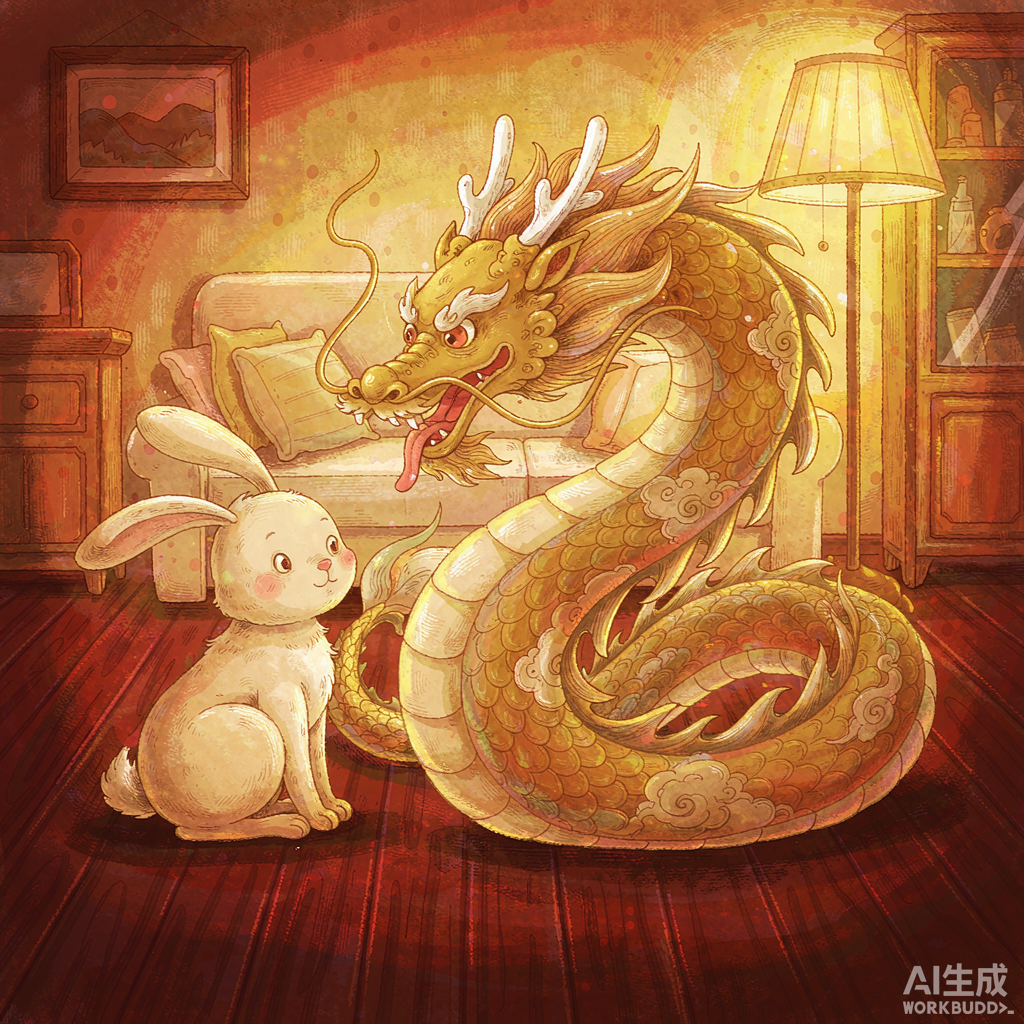
A six-harm pair: not a clash, but a tempo difference — one wants to be seen, the other wants to be safe.
The animals are a shorthand for behavior, not a verdict. If you read them as descriptions of how two people show up — who performs and who withdraws, who charges and who tests the ground — the Dragon-and-Rabbit pairing stops being a "rating" and becomes a recognizable, steerable dynamic you can actually manage.
Why Dragon and Rabbit are a "needs understanding" pair
They sit in the six-harm column of the traditional system, one step gentler than a full six-clash. What that means in real life is that their strengths pull in opposite directions instead of colliding head-on. The Dragon is built outward: big plans, big energy, a need to be witnessed and admired. The Rabbit is built inward: gentle, cautious, conflict-avoidant, happiest when the room is safe and the volume is low. Neither is wrong. They are just calibrated to different social speeds, and most of the trouble starts when each fills the other's silence with a story about themselves.
That is also why this pair gets mislabeled as "doomed" by people who only read the list. The friction is not about trust or love. It is about visibility and pace — two things you can name and adjust, which is most of what any compatibility label is actually good for.
The three observable ways a Dragon-Rabbit pair actually behaves
Most of what gets called "incompatibility" between these two comes down to three repeatable patterns. Watch for these rather than for a star rating.
1. The stage and the safe corner. The Dragon wants to be out, seen, and celebrated; it processes life by performing it a little. The Rabbit wants the private, quiet corner where it can lower its shoulders. The Dragon experiences the Rabbit's retreat as coldness or quiet disapproval; the Rabbit experiences the Dragon's spotlight as pressure and a little invasion. Neither is true. They are just standing in different rooms, and the fix is to stop treating the other's room as an insult.
2. Momentum versus caution. The Dragon charges toward the big vision immediately and trusts the landing will appear. The Rabbit moves carefully, tests the ground, and dislikes being rushed into a decision. The Dragon reads the Rabbit's caution as fear or indecision; the Rabbit reads the Dragon's charge as recklessness. The clash here is pure tempo: one wants the green light now, the other wants to check the road first. Named out loud, it becomes a scheduling conversation instead of a character judgment.
3. The unsaid argument. The Dragon will fight out loud and then consider it finished. The Rabbit will not fight at all in the moment — it goes quiet, leaves the room, or simply stores the grievance and carries it. So this pair often has no open arguments, which looks peaceful from the outside and feels hollow from the inside. The Dragon thinks "we're fine, we never fight," while the Rabbit is quietly holding something unresolved. That gap is the pair's real fault line, and it has nothing to do with how much they care.
"My Rabbit partner goes quiet every time we disagree — are they okay, or just enduring me?"
This is the most common Dragon-Rabbit worry, and the quiet is almost never endurance. It is the Rabbit's conflict style: under pressure it retreats to safety rather than escalating. The danger is the Dragon filling that silence with its own narrative — "they don't care," "I'm too much for them" — and then performing harder to win back approval, which only makes the Rabbit retreat further.
If you are the Dragon, do not read silence as rejection; give the Rabbit a low-pressure doorway to surface the thing later, when the volume is down. If you are the Rabbit, know that your quiet reads as a verdict to a Dragon, so one sentence of "I'm fine, I just need a minute" does the work of an hour of reassurance from anyone else. The match is not broken; it is waiting for the right decibel level to talk.
Four concrete fixes that keep a Dragon-Rabbit pair close
None of these require changing who you are. They require naming the lanes you are already in.
1. The Dragon builds the stage, the Rabbit builds the shelter. The Dragon owns the adventure and the outward life — the trips, the big gestures, the social gravity. The Rabbit owns one safe, quiet routine that never changes: the slow Sunday, the unspoken dinner, the corner of the house that stays calm. When each has their lane, the Dragon stops hunting for approval in the Rabbit's silence and the Rabbit stops bracing against the Dragon's noise. That division is the whole match, made visible.
2. Name the volume in numbers. Before a busy stretch, the Dragon says how many big social things it wants; the Rabbit says how many quiet nights it needs. Numbers, not moods. "Two outings, three nights in" prevents the Dragon from over-filling the calendar and the Rabbit from silently drowning — and it turns the visibility gap from a character flaw into a shared schedule you both agreed to.
3. Run the afterglow check-in. Because the Rabbit will not fight in the moment, the Dragon must actively close the loop 24 to 48 hours later: "anything still bothering you from the other night?" Do not assume silence means resolved. That one doorway lets the Rabbit surface the thing it was holding, and it defuses the unsaid argument before it turns into a month of distance.
4. Reframe the retreat. The Dragon's reflex is to read the Rabbit's quiet as disapproval and then perform harder to fix it. Change the story: the Rabbit's quiet is the trust that you will not blow up, the relief of finally not having to perform. When the Dragon stops performing for approval and just is, the Rabbit's corner opens up — and the pair finally gets the closeness the label said it couldn't have.
Questions people ask about Dragon and Rabbit compatibility
Are Dragon and Rabbit compatible?
Closer than the old "six-harm" tag suggests, but it takes a little intention. The friction is visibility and tempo, not values or trust — which means it is adjustable instead of fatal. A pair that knows its pattern in advance can defuse it in advance, and that is most of what any compatibility label is actually worth.
Why do we never fight but still feel distant?
That is the classic Dragon-Rabbit pattern. The Dragon fights out loud then forgets; the Rabbit stores quietly and says nothing. No open argument does not mean resolved — it usually means the Rabbit is carrying something the Dragon never saw. The afterglow check-in (asking a day later if anything is still bothering them) is the single habit that closes that gap.
Which other signs does the Dragon match well with?
The Dragon's trine mates are Rat and Monkey — the three momentum-lovers who enjoy the show. But the Dragon's sharpest contrast is its six-clash with the Dog, where two strong wills collide head-on, and its intense "needs understanding" pairing with the Snake, where the friction is control rather than tempo. For the opposite end of the Dragon spectrum, see our breakdown of Dragon and Dog compatibility and Dragon and Snake to see how the same sign behaves in very different rooms.
Which other signs does the Rabbit match well with?
The Rabbit's trine mates are Goat and Pig — the peacekeepers who share its need for a gentle, low-drama life. The Rabbit's hardest traditional pairings are the Rooster (a six-clash of bluntness versus sensitivity) and the Dragon, where the friction is spotlight versus safety. If you want to see another "labeled mismatch" handled with the same calm method, our piece on Ox and Goat covers a parallel case of two gentle signs grating at a different angle.
Does a "needs understanding" label mean we're doomed?
No. The label describes a pairing pattern, not your behavior. Two Dragons and two Rabbits, or any other combination, can double a strength and double a weakness in completely different ways — the sign is a starting hint, not a sentence. For the general method of staying close through a labeled mismatch, our guide to staying despite a clash applies just as well here. And for the broader picture beyond romance, the friendship compatibility breakdown shows how the same animals score when "who is in charge" is not on the table.